
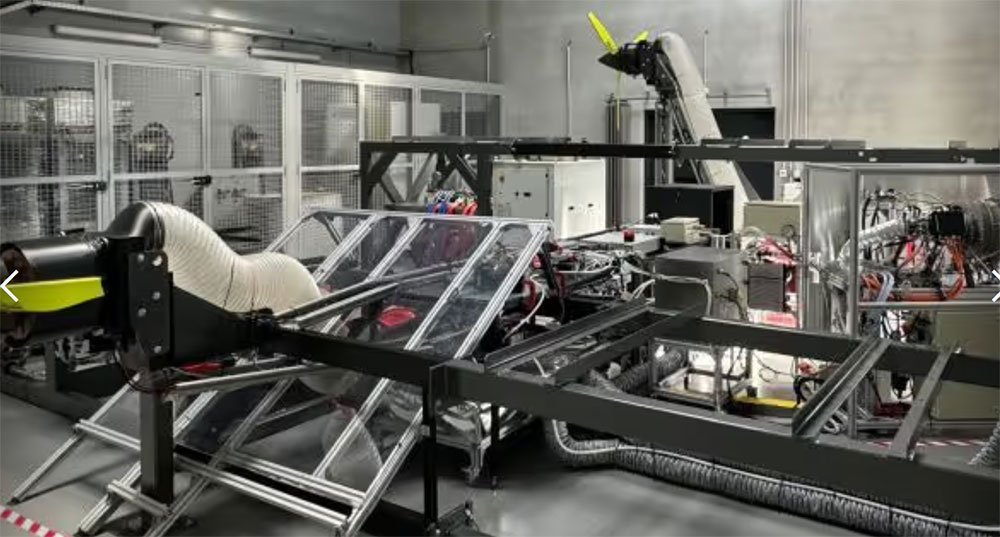
The Toulouse-based developer has reached a concrete structural milestone with its hybrid-electric VTOL demonstrator, following four years of propulsion bench testing and avionics validation that preceded full system integration.
Ascendance has announced that the physical structure of its ATEA hybrid-electric vertical take-off and landing (VTOL) demonstrator is now complete at its Toulouse facility, with the programme moving into full system integration. The airframe was manufactured by DUQUEINE Group, an industrial partner with established expertise in aeronautical composite structures. While the announcement might read as a production milestone, the significance lies in what preceded it: years of subsystem validation that the company says were intentionally completed before committing to hardware integration.
What the Milestone Actually Represents
In rotorcraft and VTOL programmes, the completion of an airframe structure is a straightforward manufacturing event. What distinguishes the ATEA milestone is the sequencing: Ascendance reports that its hybrid propulsion system — marketed as STERNA — has accumulated over 500 hours of bench testing across four years before a single unit was installed in the demonstrator. This approach, running propulsion and avionics validation in parallel with structural design rather than after it, reduces integration risk and shortens the iteration cycle once hardware assembly begins.
The STERNA system integrates Safran's ENGINeUS electric motor within a hybrid-electric distributed propulsion architecture. Integration of that system, along with fly-by-wire flight controls and full avionics, now constitutes the immediate next phase of the programme. Fly-by-wire architectures carry particular weight in this context: they are central to more-electric aircraft certification pathways and represent a meaningful regulatory and engineering commitment for a demonstrator of this scale.
Avionics Validation and Regulatory Groundwork
Alongside the propulsion bench work, Ascendance conducted flight simulation campaigns integrating a complete cockpit, onboard systems, and ground communications. These sessions involved both the company's own test pilots and EASA-certified pilots — a detail worth noting, given that early engagement with the regulatory framework tends to surface compliance issues at a point where addressing them remains manageable. The company states that these simulation campaigns were directed in part at validating control laws and demonstrating alignment with regulatory requirements, though formal certification of ATEA itself has not been announced as an imminent objective.
The involvement of EASA-certified pilots in pre-integration simulation is a methodologically sound approach for a programme that will eventually require demonstration of airworthiness to European regulators. It also provides a degree of independent verification for the control architecture — relevant given that distributed propulsion with fly-by-wire controls introduces failure mode considerations that differ substantively from conventional rotorcraft designs.
The STERNA Technology and Its Parallel Deployment
ATEA does not exist in isolation within Ascendance's portfolio. The company has been licensing and deploying its STERNA hybrid-electric propulsion technology separately, including in the unmanned aerial vehicle sector and in civil aviation partnership programmes. This parallel commercial activity serves an engineering function as well as a commercial one: it provides operational data on hybrid propulsion performance across varied mission profiles and environmental conditions — data that feeds back into the demonstrator programme.
This model, developing a core technology platform that generates revenue and operational evidence while the flagship demonstrator matures, is a pragmatic structure for a company at Ascendance's stage of development. It reduces the degree to which the entire programme depends on ATEA achieving flight test milestones on a fixed schedule, and it provides investors and partners with evidence of technology readiness that predates first flight.
Dual-Use Positioning and European Industrial Context
Ascendance frames ATEA as a dual-use platform, with stated applications spanning passenger transport, cargo, medical logistics, and security and defence missions. Dual-use positioning is common among European VTOL developers in part because it opens access to defence procurement budgets that are structurally more predictable than early urban air mobility commercial markets. It also aligns with broader European Union policy objectives around strategic autonomy in critical aerospace sectors.
The programme is assembled around a French and European industrial supply chain — design and final assembly in Toulouse, composite manufacture through DUQUEINE, propulsion hardware through Safran. This configuration has both industrial and political relevance in the current European defence and aerospace environment, where sovereign capability in advanced propulsion and autonomous flight systems has moved up the policy agenda. Whether Ascendance is in a position to serve defence customers at programme scale depends on outcomes that the ATEA demonstrator is intended to validate, but the supply chain structure is consistent with those ambitions.
What Comes Next
With the airframe structure complete, the programme now moves to the installation of propulsion, avionics, and flight control systems. This integration phase is typically where schedule risk accumulates: interface issues between subsystems, cable routing constraints, and weight and balance adjustments tend to absorb more time than projected. The fact that Ascendance has conducted extended bench testing and flight simulation before this phase does not eliminate integration risk, but it does mean that the major unknowns in propulsion performance and control law behaviour have been addressed prior to hardware assembly.
Ground testing following integration will be the next substantive milestone to watch, followed by tethered hover trials and eventually free flight. Ascendance has not published a specific timeline for first flight. For professionals tracking European hybrid-electric VTOL development, the completion of the ATEA structure marks a legitimate transition from an engineering design programme to an active hardware programme — a distinction that carries weight when assessing the credibility of a developer's technical claims and commercial positioning.