
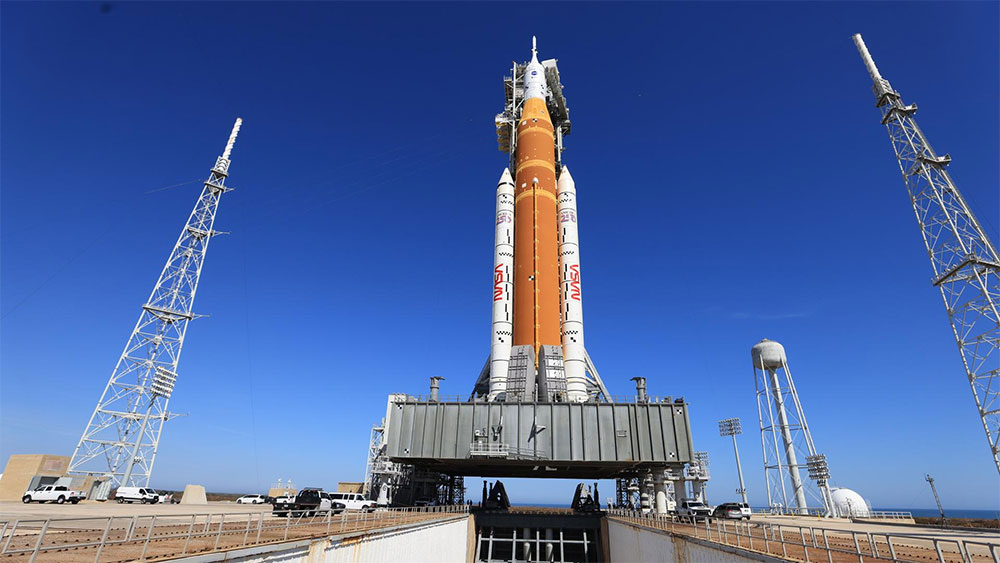
For the first time since Apollo 17 departed for the lunar surface in December 1972, human beings are preparing to leave low Earth orbit. NASA's Artemis II mission, currently targeting no earlier than March 6, 2026 from Launch Complex 39B at Kennedy Space Center in Florida, will carry four astronauts on a ten-day free-return trajectory around the Moon — a mission profile that the aviation and aerospace community has been watching closely as both a technical validation exercise and a signal of where the broader industry is heading.
The Mission in Brief
Artemis II will fly NASA astronauts Reid Wiseman (commander), Victor Glover (pilot), and Christina Koch (mission specialist), along with Canadian Space Agency astronaut Jeremy Hansen, aboard the Orion spacecraft.
The vehicle will be lifted by the Space Launch System, SLS, a heavy-lift rocket capable of generating approximately 8.8 million pounds of thrust, meaningfully more than the Saturn V's 7.6 million pounds. The crew will not land on the lunar surface. The mission's primary purpose is to validate the integrated performance of SLS and Orion in the deep space environment, including crew systems, life support, communications, and reentry dynamics.
The trajectory is designed with a safety margin built in from the outset. Even in the event of a main propulsion failure, Orion's free-return path would bring the crew back to Earth without requiring an engine burn — a design consideration that reflects lessons absorbed from decades of human spaceflight risk management.
Where Things Stand Technically
The road to launch has not been without friction. Engineers identified heat shield anomalies on the Orion capsule that flew on the uncrewed Artemis I mission in November 2022, contributing to multiple schedule revisions for Artemis II. More recently, a wet dress rehearsal conducted in early February 2026 revealed higher than acceptable hydrogen gas concentrations at seal interfaces on the SLS, prompting teams to replace components and conduct a second rehearsal later that month. As of late February 2026, NASA has confirmed March 6 as the earliest viable launch window pending completion of a Flight Readiness Review and resolution of remaining technical work at the pad.
The European Service Module (ESM), built by Airbus under contract to the European Space Agency, provides Orion's propulsion, power, thermal regulation, water, and atmosphere in space. Its successful integration into the mission architecture represents one of the more substantive international partnerships in human spaceflight, with hardware contributions from across Europe feeding directly into a crewed American lunar mission.
Significance for the Aerospace and Aviation Industry
For professionals working in aerospace systems, propulsion, avionics, materials, or flight operations, Artemis II carries practical significance that goes beyond its symbolic value. The mission will generate real-world data on how modern avionics and crew systems perform beyond the Van Allen belts, where radiation exposure and communication delays present challenges that low Earth orbit operations do not fully replicate.
Orion's reentry profile is also technically noteworthy. The spacecraft is expected to hit Earth's atmosphere at approximately 25,000 miles per hour — faster than any crewed vehicle has reentered since the Apollo era — using a skip reentry technique that manages the deceleration load and thermal environment. This approach, and the performance of the Orion heat shield under those conditions, will be closely scrutinized by engineers working on future crewed vehicles intended for deep space return trajectories.
The AVATAR payload (A Virtual Astronaut Tissue Analog Response), flying on Artemis II for the first time beyond the International Space Station and the Van Allen belts, uses organ-on-a-chip technology to study radiation and microgravity effects on human physiology. The data gathered will inform life support and crew health system design for future long-duration missions — a design challenge that aerospace engineers working on any crewed deep space architecture will eventually need to address.
The Broader Programme Context
Artemis II sits within a programme that has faced sustained scrutiny over its cost structure and schedule credibility. The SLS costs approximately four billion dollars per launch, a figure that has drawn consistent criticism and led the Trump administration's fiscal year 2026 budget proposal to recommend terminating the rocket after Artemis III. The One Big Beautiful Bill Act, signed into law in July 2025, allocated funding to continue SLS and Orion beyond that point, but the long-term trajectory of the programme's architecture remains subject to political and budgetary variables that the industry should factor into planning horizons.
Artemis III, the mission intended to place astronauts on the lunar surface for the first time since 1972, has itself slipped to no earlier than 2028 as of current official projections. That mission relies on SpaceX's Starship as the Human Landing System, a vehicle that requires orbital propellant transfer at significant scale — a capability that has not yet been fully demonstrated. NASA opened the lunar lander contract to competing bids in October 2025 in light of the delays, introducing additional uncertainty into that programme element.
A Measured Assessment
Artemis II is a meaningful technical milestone rather than a destination in itself. If the mission proceeds as planned, it will demonstrate that NASA and its international partners have restored the capability to send humans safely beyond Earth orbit — a capability that has been absent for over half a century. The data it returns will shape the design and risk posture of every subsequent crewed lunar mission, and its operational lessons will ripple into the broader commercial deep space sector that is developing in parallel.
For aviation and aerospace professionals, the mission is worth tracking not only for its immediate outcomes, but for what it reveals about the maturity of the systems and supply chains that the next decade of crewed deep space operations will depend upon. The gap between what Artemis II demonstrates and what Artemis III requires remains considerable. How that gap is closed — and by whom — will define much of the industry's direction through the 2030s.