
Returning to the Moon in Steps: What NASA's Artemis Restructure Means
In late February and early March 2026, NASA announced a major overhaul to its Artemis moon program, described as a "course correction" that will add missions and increase the pace of launches ahead of a targeted lunar landing attempt in 2028. The announcement, made by NASA Administrator Jared Isaacman at Kennedy Space Center in Florida, revises the sequence and scope of upcoming missions and marks a deliberate shift in strategy. For professionals in the arts and cultural sector who engage with science, technology, and space themes in their programmes and exhibitions, understanding what has changed — and why — provides useful context for conversations with audiences, funders, and collaborators.
The Situation Before the Announcement
The Artemis programme has been underway for several years, beginning with an uncrewed test flight — Artemis I — in November 2022. The next mission, Artemis II, is designed to carry four astronauts on a ten-day journey around the Moon and back, without landing. That crew — NASA astronauts Reid Wiseman, Victor Glover, and Christina Koch, along with Canadian Space Agency astronaut Jeremy Hansen — has been in training for some time, but the mission has encountered repeated technical delays. A leaking hydrogen problem at the base of the Space Launch System rocket, uncovered during a key fuelling test, forced NASA to forgo all available launch opportunities in February. Engineers subsequently uncovered a blockage in the flow of helium to part of the booster's upper stage, which ruled out launch attempts in March, and the rocket was rolled back to its hangar for repairs. Officials said Artemis II could launch in early April if that work proceeds as planned.
Alongside these immediate difficulties, there had been a longer-term concern about the original roadmap. The announcement came two days after the release of a sharply-worded report from NASA's independent Aerospace Safety Advisory Panel, which deemed the existing plans too risky. The panel raised concerns about the number of "firsts" required by the original Artemis III moon landing mission and recommended that NASA "restructure" the programme to create a more balanced risk posture.
What Has Changed
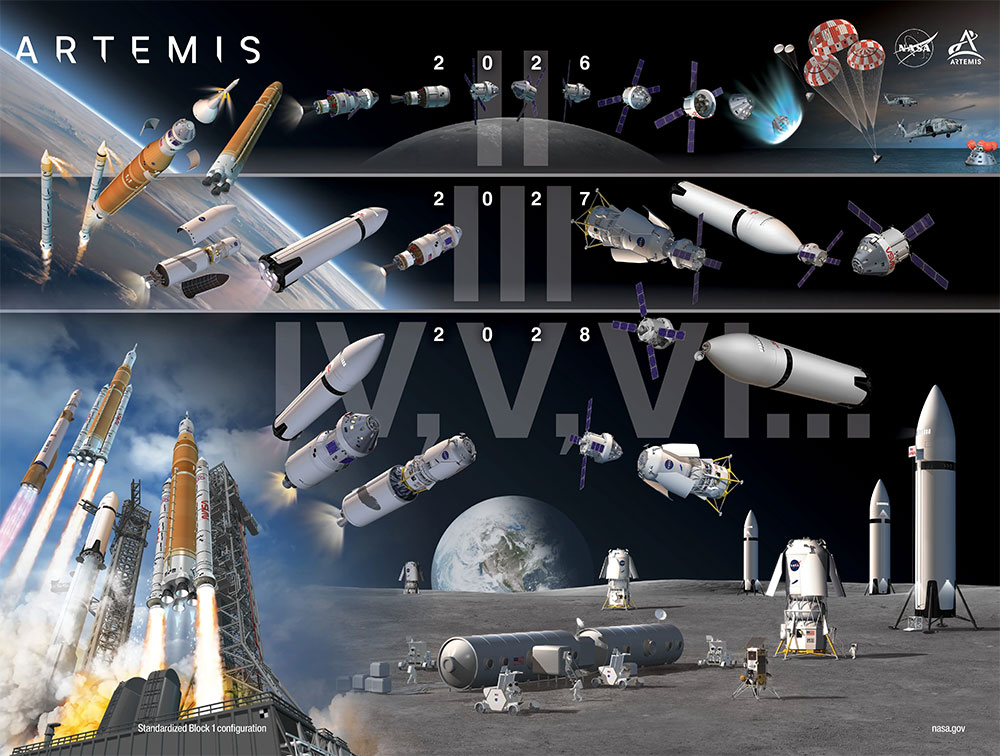
The core of the March announcement is the insertion of an additional mission into the programme sequence and a redefinition of what each mission is expected to achieve.
Artemis III, now scheduled for 2027, will no longer be positioned as the first crewed lunar landing of the programme. Instead, it will focus on systems validation in low Earth orbit ahead of an Artemis IV landing mission targeted for 2028. Under the revised plan, Artemis III will test operational capabilities including rendezvous and docking with one or both commercial lunar landers being developed by SpaceX and Blue Origin. The new generation of spacesuits intended for lunar surface use will also be evaluated in microgravity during this mission.
NASA is also increasing its cadence of missions with the aim of undertaking at least one surface landing every year from 2028 onwards. A significant engineering decision accompanies this restructuring. The agency is no longer planning to use the Exploration Upper Stage or Mobile Launcher 2, as development of both has encountered delays. NASA has instead chosen to standardise the Space Launch System rocket in its current Block 1 configuration for all near-term missions. The rationale is that using a consistent, already-certified vehicle reduces the variables that must be managed from one flight to the next.
Administrator Isaacman framed the philosophy explicitly in terms of the Apollo programme: "Standardising vehicle configuration, increasing flight rate, and progressing through objectives in a logical, phased approach, is how we achieved the near-impossible in 1969 and it is how we will do it again." The comparison to Apollo is deliberate and widely noted by aerospace observers. The original Moon programme also proceeded in careful increments — testing the command module separately before combining it with the lunar module, and conducting an orbital mission before attempting a landing.
The Broader Context
NASA also linked the accelerated cadence to a recently announced workforce directive aimed at rebuilding in-house engineering capability. The agency says expanding civil servant involvement alongside commercial partners will support safer and more reliable operations as flight frequency increases. Boeing, the prime contractor for the SLS core stage, indicated readiness to support the revised tempo of production, which will place greater demand on manufacturing and supply chains.
The geopolitical dimension of the programme featured prominently. Administrator Isaacman cited intensifying competition from the United States' "greatest geopolitical adversary" as a driver for the need to move faster and eliminate delays. That competitive framing has been a consistent element of the political case for Artemis since its inception, and it continues to shape how the programme is presented to Congress and the public.