
A Framework for the Skies
How the U.S. Department of Transportation's 2025 AAM integration program sets the terms for the next decade of American aviation
The Policy Context
On December 17, 2025 the U.S. Department of Transportation released two foundational documents that together constitute the federal government's first coordinated policy framework for advanced air mobility: the Advanced Air Mobility National Strategy and its companion Comprehensive Plan. Transportation Secretary Sean Duffy convened industry leaders and senior officials from across the federal government at DOT headquarters , signalling that the administration views AAM integration as a generational undertaking rather than a near-term regulatory exercise.
The legal foundation for this effort dates to 2022, when Congress passed the Advanced Air Mobility Coordination and Leadership Act, directing DOT to convene an interagency working group and develop a concrete national strategy. That working group ultimately drew on the participation of 25 federal agencies and more than 100 subject-matter experts. The resulting strategy — subtitled 'A Bold Policy Vision for 2026–2036' — represents a decade-long commitment to bringing eVTOL aircraft, advanced regional aircraft, autonomous cargo platforms, and related technologies into structured, safe, and commercially viable operation within the National Airspace System.
AAM is defined in the strategy not as a single technology but as a collection of emerging aircraft types and enabling systems — most notably electric vertical takeoff and landing (eVTOL) vehicles operating below 5,000 feet, alongside short takeoff and landing aircraft and highly automated platforms. DOT estimates the existing U.S. aviation industry supports approximately $1.8 trillion in economic activity and contributes around 4 percent of GDP. The strategy positions AAM as a potential structural addition to that ecosystem rather than a peripheral niche.
Seven Pillars, Forty Recommendations
The strategy is organised around seven foundational pillars: Airspace Modernisation, Advanced Infrastructure, Adaptive Security, Community Planning and Engagement, Ready Workforce, Applied Automation, and a set of Overarching Recommendations. Across these pillars, the document issues 40 specific recommendations directed at a range of federal actors including DOT, the FAA, the Department of Homeland Security, and NASA. The breadth of the recommendation set reflects the degree to which successful AAM integration cuts across traditional agency jurisdictions — covering not only airspace management and aircraft certification, but also workforce development, vertiport siting, cybersecurity standards for automated systems, and local planning coordination.
On the question of regulatory architecture, the strategy signals federal receptivity to industry-led solutions, particularly in areas such as aircraft certification pathways, air traffic management tools, and vertiport design standards. This posture reflects a broader administration philosophy of deferring to private sector expertise where safety standards can be maintained, and it distinguishes the current approach from the more prescriptive regulatory tendencies of prior federal aviation policy cycles. Whether this openness translates into durable certification timelines remains the operational question for manufacturers.
The infrastructure pillar addresses one of the more practical constraints on early AAM operations: where and how aircraft will land. The strategy explicitly encourages use of existing and repurposed infrastructure as the near- and medium-term solution, acknowledging that purpose-built vertiport networks will require time, capital, and local planning coordination that cannot be assumed to arrive ahead of initial operations. This is a realistic assessment that aligns with the operational strategies several leading manufacturers have already adopted.
The LIFT Framework and Implementation Timeline
The Comprehensive Plan organises implementation into four overlapping strategic phases captured under the acronym LIFT: Leverage Existing Programs to Support Innovation and Begin Operations; Initiate Engagement with Partners, Research and Development, and Smart Planning; Forge New Policy and Models Responsive to Public Needs; and Transform the Aviation Ecosystem. These phases are not sequential in the strict sense — they are designed to overlap and reinforce one another as capabilities, regulatory tools, and stakeholder relationships mature in parallel.
The strategy sets out a specific milestone calendar. Initial demonstrations and commercial operations are projected to begin in 2027, a date that will require the FAA to complete or substantially advance type certification for at least some eVTOL platforms currently in development. By 2030, the strategy anticipates new air operations in multiple urban and rural environments, including powered-lift aircraft in service and short-takeoff-and-landing flights expanding access in areas currently underserved by commercial aviation. The final transformation phase envisions standardised technologies and procedures enabling scaled AAM operations integrated with conventional aircraft, unmanned systems, and broader smart transportation networks — a horizon the plan places beyond 2030.
To maintain implementation pace, the Comprehensive Plan recommends standing up a White House-level interagency working group to oversee execution of the strategy's recommendations. This structural proposal reflects an understanding that cross-agency coordination of this complexity requires sustained executive-level attention, not merely periodic interagency consultation. Aviation professionals familiar with previous federal technology integration efforts — including the decades-long transition to ADS-B — will recognise the significance of that recommendation.
The eVTOL Integration Pilot Program
Separate from, but closely related to, the National Strategy is the eVTOL and Advanced Air Mobility Integration Pilot Program (eIPP), which was established pursuant to Executive Order 14307 — signed in June 2025 — and announced through the Federal Register in September 2025. The FAA is targeting an early 2026 launch for the program. The eIPP operates through public-private partnership agreements between the FAA and state, local, tribal, or territorial governments paired with private sector partners that have demonstrated AAM development, manufacturing, or operational experience.
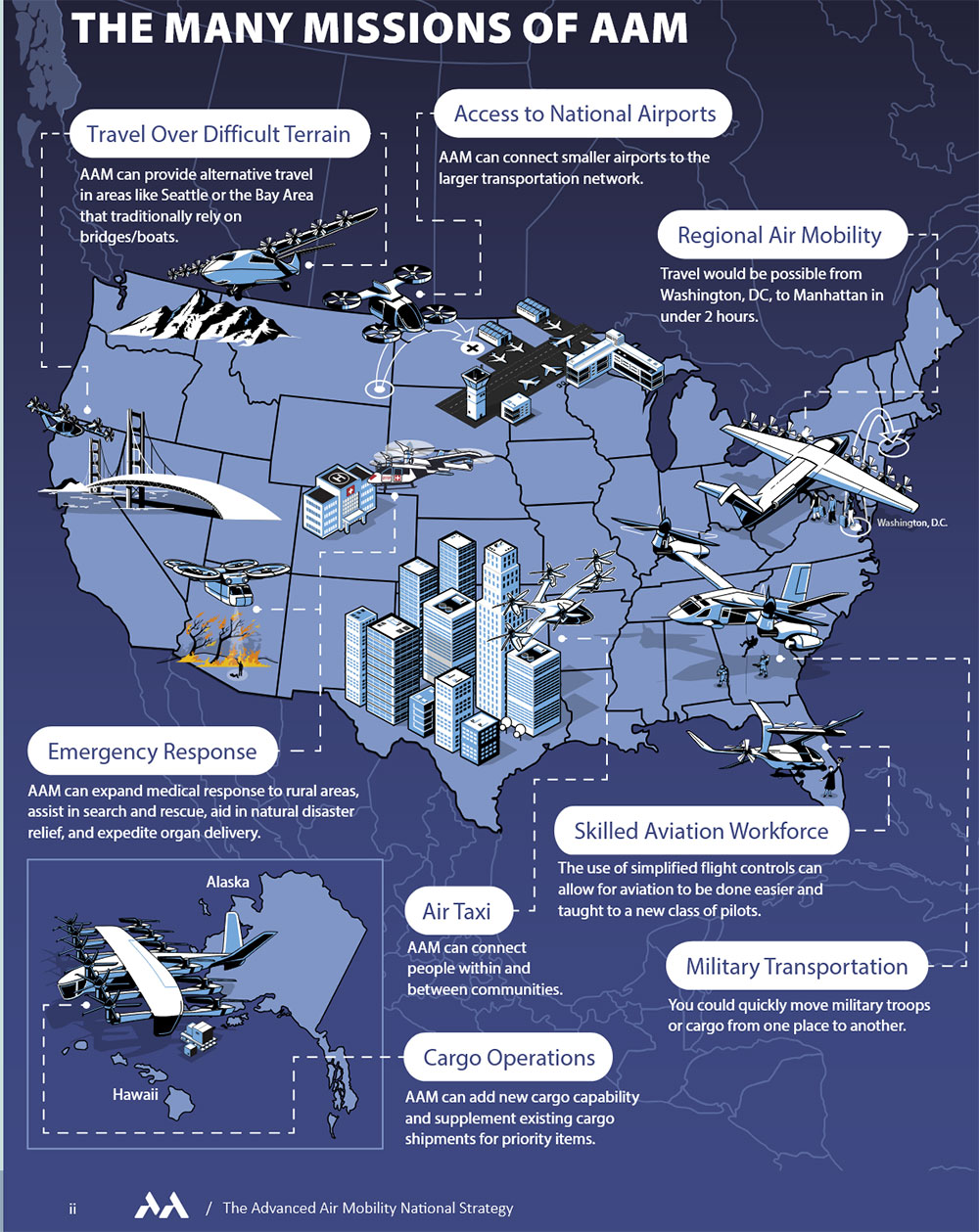
The pilot program covers a broad spectrum of use cases: short-range on-demand air taxis, longer-range advanced regional aircraft with short takeoff and landing capability, logistics and cargo delivery, offshore energy support operations, medical transport, and automation safety demonstrations. Operationally, the program's primary purpose is data generation. Operational data and lessons learned from eIPP partnerships will be made publicly available — subject to agreed-upon restrictions on confidential or proprietary information — and will directly inform the FAA's regulatory and safety framework for the broader AAM sector. In this respect, the eIPP functions as a structured evidence base for future rulemaking rather than a commercial authorisation pathway.
For manufacturers currently navigating FAA type certification, the eIPP creates an important parallel track. Early operational experience under the program — including data on airspace integration, noise profiles, and ground operations at existing and repurposed infrastructure — can run concurrently with certification campaigns and provide regulators with real-world evidence that certification processes alone cannot generate.
Industry Response and Near-Term Implications
Senior leadership from Archer, BETA Technologies, Eve Air Mobility, Joby Aviation, and Wisk were among those present at DOT headquarters for the December 17 unveiling, and each company subsequently expressed public support for the strategy. The industry's welcome is grounded in practical terms: the strategy provides regulatory clarity, signals multi-agency coordination, and indicates federal funding mechanisms and infrastructure investment will be part of the picture. The National Business Aviation Association also expressed support, with its representative noting that the plan — coordinated across 25 federal agencies — clears a path for AAM aircraft to enter the national airspace system on structured terms.
The 2027 initial operations milestone is the number that carries the most consequence for manufacturers in active development today. Joby Aviation, which has logged over 50,000 flight miles including 850 flights in 2025 and has finalised its certification basis agreement (G-1) with the FAA, is positioned closer to that threshold than most. The strategy's emphasis on data sharing with government agencies aligns with what Joby and other leading developers have already been doing in the course of their certification programmes. For companies earlier in the development cycle, the 2027 target will function as a market signal rather than an achievable operational date.
For aerospace infrastructure developers, operators, and municipalities considering vertiport investment, the strategy's endorsement of existing and repurposed infrastructure as the near-term baseline is a useful clarifying signal. It reduces the pressure to commit capital to purpose-built facilities ahead of proven demand curves, while still allowing developers who are ready to move forward to do so. The community planning and engagement pillar of the strategy acknowledges that local government cooperation is not peripheral to AAM deployment — it is a prerequisite for it.
Workforce and Automation
Two pillars of the strategy merit particular attention from aviation professionals whose work sits at the intersection of operations and human factors: the Ready Workforce pillar and the Applied Automation pillar. The workforce section acknowledges that AAM will require not only pilots and mechanics trained on novel aircraft types, but a broader ecosystem of air traffic specialists, maintenance technicians, vertiport operations personnel, and software engineers familiar with aviation-grade systems. The strategy identifies workforce development as a prerequisite for successful integration rather than a downstream consideration.
The automation pillar reflects the fact that many AAM concepts are designed to operate with reduced crew requirements or full autonomy over portions of their missions. The strategy's approach here is calibrated: it supports demonstrating safe integration of aircraft with automation technologies that enhance safety and efficiency, while stopping short of prescribing the automation architecture that manufacturers must adopt. This is consistent with the broader principle of regulatory receptivity to industry solutions, and it leaves room for the diverse technical approaches currently in development — from piloted eVTOLs with enhanced automation to fully autonomous cargo platforms — to compete on demonstrated safety performance.
Assessment
The DOT's Advanced Air Mobility National Strategy and Comprehensive Plan represent the most coherent federal statement on AAM integration to date. Their value lies less in any specific regulatory decision — those remain largely ahead — and more in the coordination architecture they establish and the timeline they commit the government to defending. For an industry that has operated for years in the absence of a unified federal posture, that architecture is substantively useful.
The gap between the strategy's ambitions and the operational reality of AAM in early 2026 is considerable. FAA type certification timelines for novel aircraft categories have historically exceeded initial projections. Vertiport infrastructure, even with the endorsement of repurposed facilities, will require investment decisions that local governments and private developers are only beginning to model. And the public acceptance questions that the community engagement pillar is designed to address do not resolve themselves through federal policy alone.
None of that diminishes the significance of what was released on December 17, 2025. Aviation professionals, manufacturers, infrastructure developers, and government stakeholders now have a shared reference document — one produced with multi-agency coordination and carrying the Secretary of Transportation's imprimatur — that defines the terms of the integration conversation for the coming decade. Working within that framework, rather than alongside or around it, is likely to be the more productive posture for anyone with a material interest in how advanced air mobility develops in the United States.