
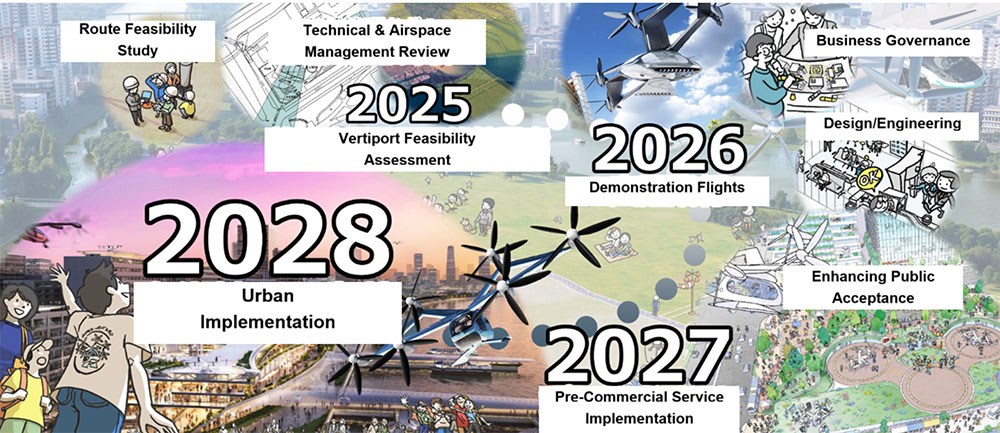
The Tokyo Metropolitan Government has selected a consortium led by Nomura Real Estate Development to carry out the first phase of its eVTOL Implementation Project, setting out a structured path from feasibility study to pre-commercial service within a four-year window.
Project Selection and Consortium Structure
In November 2025, the Tokyo Metropolitan Government announced the selection of a nine-party consortium to lead Phase I of its eVTOL Implementation Project, a programme established under the city’s 2050 Tokyo Strategy. The initiative aims to bring electric vertical take-off and landing aircraft into commercial urban operations by 2030.
Nomura Real Estate Development serves as lead company, with consortium members including ANA Holdings, SkyDrive, East Japan Railway Company, Nikken Sekkei, Aero Toyota Corporation, and Seibu Holdings. Joby Aviation and Haneda Future Development participate as cooperative partners. The breadth of the group is notable: it encompasses an aircraft manufacturer with active type certification activity in both Japan and the United States, a second aircraft developer with announced air taxi service plans in Dubai, Japan’s largest rail operator by passenger volume, a major property developer already engaged in large-scale bay-area redevelopment, and an architectural firm with a dedicated air-mobility urban-design division.
ANA Holdings and Joby Aviation had already commenced discussions in August 2025 to establish a joint venture for air taxi services in Japan, giving the consortium a pre-existing operational planning relationship between its airline and one of its two aircraft providers.
Aircraft and the Multi-Use Case Rationale
The project is structured around two distinct aircraft types rather than a single platform. SkyDrive’s SKYDRIVE aircraft, currently in production at a Suzuki Motor Corporation facility in Iwata City, Shizuoka Prefecture, is targeting type certification and commercial service launch around 2028. Joby Aviation’s aircraft, a tilt-rotor design capable of cruise speeds significantly higher than many competing configurations, brings a longer-range, higher-capacity profile to the consortium.
Operating two aircraft types within the same urban implementation programme is operationally more complex than a single-type fleet, but the consortium has framed this as a deliberate strategy: the distinct performance envelopes of the two aircraft allow different use cases to be evaluated in parallel. A smaller, lower-speed aircraft optimised for short intra-urban hops serves different infrastructure and airspace requirements than one designed for rapid inter-district connections. Running both within the same regulatory and planning framework generates comparative data that a single-aircraft study could not provide.
SkyDrive conducted demonstration flights at the Osaka-Kansai Expo in 2025, providing the company with public-facing operational experience ahead of the Tokyo project. That exposure, while limited in scope, offered a degree of real-world data on passenger interaction and ground operations that pure simulation cannot replicate.
Programme Phasing and Key Milestones
The Phase I timeline is structured in three stages. Demonstration flights are planned for Tokyo’s coastal and river areas in fiscal year 2026, providing regulators and the public with direct observation of eVTOL operations in an urban context. Pre-commercial service implementation is targeted for fiscal year 2027. From fiscal year 2028 onward, the consortium will identify and confirm final vertiport locations, with full commercial operations as the stated endpoint.
Vertiport feasibility studies and site development planning are integral to Phase I, not deferred to a later stage. The selection of coastal and river corridors for initial demonstration flights reflects both the lower overflight risk of these areas and the existing infrastructure considerations around Tokyo Bay, where Nomura Real Estate and East Japan Railway are already co-developing the BLUE FRONT SHIBAURA mixed-use complex — a twin-tower scheme with the taller structure reaching approximately 230 metres. That development context makes it a natural candidate for vertiport integration, though the consortium has not publicly designated specific final sites.
Haneda Innovation City (HICity), developed and operated by Haneda Future Development, adds an established venue with prior eVTOL exhibition experience, Level 4 autonomous bus operations, and ongoing robotics demonstration activity. Its proximity to Haneda Airport gives the consortium access to a site already accustomed to aviation-adjacent public engagement.
Regulatory and Airspace Context
Japan’s civil aviation authority, the Ministry of Land, Infrastructure, Transport and Tourism (MLIT), has been developing the regulatory framework for eVTOL type certification and operations in parallel with industry. Both SkyDrive and Joby Aviation are engaged in certification processes with the Japan Civil Aviation Bureau (JCAB) and the United States Federal Aviation Administration (FAA) respectively, and the Tokyo project sits within an environment where at least some regulatory groundwork has already been laid.
Airspace management is identified by the consortium as one of the challenges requiring resolution before commercial operations can commence. Tokyo is among the most complex airspace environments in the world, with Haneda and Narita airports generating dense controlled traffic, and low-level helicopter activity already established across the metropolitan area. Integrating eVTOL corridors without disrupting existing traffic flows will require close coordination with the JCAB and Japan’s Air Self-Defense Force, which manages certain restricted areas around the capital.
Nikken Sekkei’s participation through its Skyscape Design Lab brings an urban planning dimension that is often absent from purely aviation-led eVTOL projects. The firm has been involved in the Public-Private Council for the Air Mobility Revolution, positioning it to contribute to regulatory development from an architectural and city-planning perspective, as distinct from the aircraft certification and airspace management workstreams.
Public Acceptance as an Operational Variable
The consortium has explicitly included public acceptance enhancement as a programme deliverable, with mock-up exhibitions and public open house events planned as structured activities rather than optional outreach. This reflects a growing recognition across the eVTOL industry that social licence is a prerequisite for commercial operations, not an incidental concern.
Noise remains the most consistently cited concern in public surveys on urban air mobility. Both SkyDrive and Joby Aviation have emphasised the acoustic profiles of their respective aircraft, though comparative urban noise data under real operating conditions — factoring in rooftop vertiport placement, surrounding building height, and ambient noise floors in dense districts — will only become available through the demonstration phase itself. The coastal and riverside demonstration corridors selected for fiscal year 2026 will expose the aircraft to environments with somewhat lower baseline noise sensitivity than central commercial or residential districts, which may affect the generalisability of initial acoustic data.
Seibu Holdings’ involvement, centred on the group’s hotel, leisure, and urban transportation network, provides a distribution channel for public engagement that extends beyond aviation audiences. The group operates railway lines in western Tokyo and into Saitama Prefecture, giving the consortium access to commuter populations who represent the most plausible initial customer base for intra-urban air taxi services.
Significance for the Broader eVTOL Sector
The Tokyo project is one of several major urban eVTOL implementation initiatives currently under active development globally, but it carries particular weight given the density and infrastructure complexity of its operating environment. If the consortium achieves pre-commercial service in fiscal year 2027 as planned, it would place Tokyo among the first tier of cities to demonstrate scheduled eVTOL operations, alongside Dubai, where Joby Aviation has separately announced a 2026 service commencement.
For SkyDrive specifically, the project represents a transition from demonstration activity — the Osaka Expo flights were conducted under controlled conditions with limited operational duration — to sustained urban programme participation. Meeting the fiscal year 2028 commercial launch target while simultaneously contributing to an active pre-commercial implementation scheme in Tokyo implies a certification timeline with limited margin for delay.
For Joby Aviation, the Tokyo project extends its operational geography beyond the United States and the Gulf region, and deepens its relationship with ANA Holdings ahead of what the two companies have described as a joint venture for Japanese air taxi service. The Tokyo Bay corridor, with its established international business and hospitality infrastructure, aligns with the airport-connection use case that Joby has positioned as its primary early market.
The composition of the consortium also illustrates a structural feature of the Japanese urban air mobility market: unlike some markets where a single airline or mobility operator has sought to control the full value chain, the Tokyo project distributes roles across real estate, rail, aviation, architecture, geospatial services, and hospitality. Whether that breadth proves an operational advantage or introduces coordination overhead will become apparent as the programme moves from feasibility study into the demonstration phase.
This article is based on publicly available information released by SkyDrive Inc. and the Tokyo Metropolitan Government. It does not constitute investment advice or regulatory guidance.