
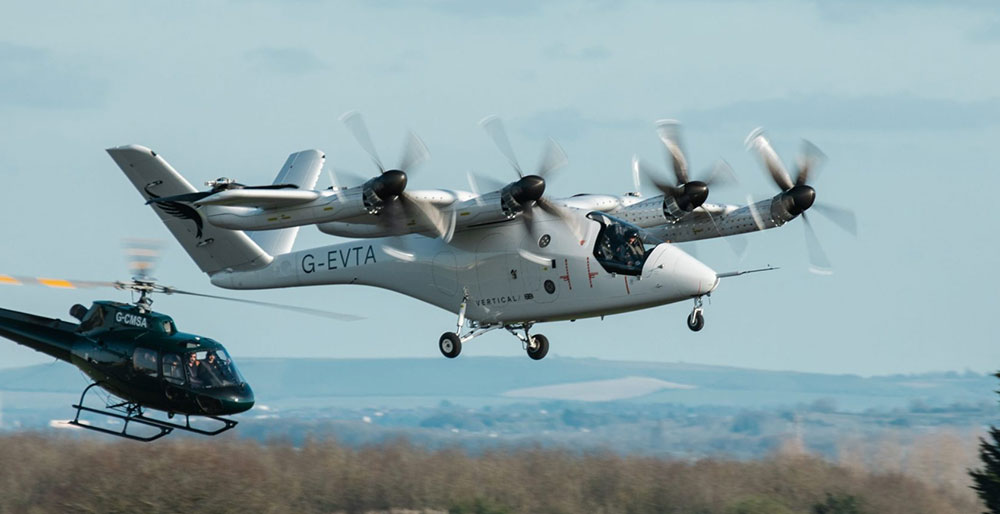
On 2 April 2026, test pilot Paul Stone flew Vertical Aerospace's full-scale Valo prototype through the first piloted thrustborne transition by an aircraft of its class under UK Civil Aviation Authority oversight — marking the completion of the first half of the two-way transition sequence required for type certification.
The Flight
At Vertical Aerospace's flight test centre at Cotswold Airport, Paul Stone lifted the Valo prototype vertically from the runway on 2 April 2026. As the aircraft climbed, its front propellers tilted progressively forward, transferring lift from thrust to wing. The rear propellers stowed as the aircraft accelerated into conventional wingborne cruise. Stone then completed the sequence with a standard runway landing.
The manoeuvre — known as thrustborne transition — is the defining aerodynamic challenge of the eVTOL configuration. It requires the aircraft to transfer its primary lift mechanism from distributed electric propulsion in hover to the fixed wing in cruise, all while maintaining stable, controlled flight. For a tilting-rotor design such as Valo, the transition must be managed through a precise choreography of propeller angle, airspeed, angle of attack, and power distribution across eight independently controlled propulsion units.
Stone described the aircraft's behaviour as consistent with simulator predictions throughout. In the company's official release he noted that the response was smooth and stable from the moment the front propellers began to tilt, giving him confidence in the engineering team's work. Chief Engineer David King confirmed that the aircraft performed precisely as designed, validating the distributed electric propulsion and tiltrotor technology at full scale in real flight conditions.
This flight represents the completion of what Vertical terms the first half of the two-way transition sequence. The remaining task is to demonstrate the reverse: decelerating from wingborne cruise back into hover and landing vertically without the need for a runway. That capability is the operational foundation of the advanced air mobility business case, enabling point-to-point flight between vertiports, helipads, and rooftop landing zones.
Regulatory Context and Certification Progress
The flight was conducted under a Permit to Fly issued by the UK Civil Aviation Authority, which is working in close collaboration with the European Union Aviation Safety Agency toward certification of the Valo aircraft. Each expansion of the flight envelope is preceded by structural testing, systems validation, simulator work, and the submission of evidence packages to regulators. The process reflects the Enhanced category requirements under the SC-VTOL standard — the same level of safety expected of commercial passenger airliners.
Vertical's Director of Regulatory Affairs, Trevor Woods, brings relevant pedigree to this relationship. He previously served as Certification Director and Flight Standards Director at EASA, and in multiple senior roles at the UK CAA over more than two decades, including Head of UK Aeroplanes and Rotorcraft Certification. The company's regulatory strategy reflects an intent to build an evidence base in lockstep with the authorities rather than to present a completed aircraft for retrospective review.
The flight test programme is structured in four phases. Tethered hover was completed in September 2024. Free-flight thrustborne operations — encompassing vertical take-off, landing and low-speed manoeuvring — were completed in February 2025. Wingborne flight, using conventional take-off and landing, was completed in September 2025. The current phase, transition, is now partially complete with the first (thrustborne to wingborne) direction demonstrated. The programme's final step before certification testing is the return direction: wingborne to thrustborne, culminating in vertical landing.
About Vertical Aerospace
Vertical Aerospace was founded in Bristol, United Kingdom, after its founder found himself caught in a two-hour traffic gridlock in São Paulo and began thinking about urban mobility from a different angle — upward. The company has since grown into a publicly listed aerospace and technology company (NYSE: EVTL) with approximately a decade of operating history, headquartered in Bristol with a London office, a flight test centre at Cotswold Airport in Kemble, and a dedicated battery facility — the Vertical Energy Centre — also in Bristol.
The leadership team draws from the top tier of civil and military aerospace. Chief Executive Officer Stuart Simpson previously served as CFO of FTSE 100 company Avast plc and in Interim CEO, CFO and COO roles at Royal Mail, with earlier career positions at General Motors, Rolls-Royce, and Bentley. Chief Engineer David King spent seven years as Leonardo's Chief Engineer on the AW609 tiltrotor programme before joining Vertical. Chief Test Pilot Simon Davies is a Category 1 test pilot trained at the US Naval Test Pilot School at Patuxent River, with more than 3,000 hours across over 70 aircraft types including aeroplanes, helicopters, and eVTOL aircraft. Programme Director Martyn Ashford brings more than 27 years of executive experience at Leonardo, including as Programme Director for the Next Generation Civil TiltRotor.
Collectively, Vertical's senior engineering team has certified and supported more than 30 civil and military aircraft and propulsion systems. The company's approach to the Valo programme is shaped by that experience — an emphasis on systematic flight envelope expansion, early and continuous regulatory engagement, and a supply chain built around established aerospace partners.
The Valo Aircraft
Valo is a piloted, four-passenger eVTOL aircraft designed for zero operating emissions. It uses eight tilt-shift propellers in a distributed electric propulsion arrangement, with the front four capable of tilting forward to enable the transition from hover to wingborne flight. The aircraft is designed for a cruise speed of 150 mph and a range of approximately 100 miles, with a noise signature intended to be near-imperceptible in urban environments.
The airframe is a carbon composite structure produced with the involvement of Syensqo, Leonardo, and Aciturri. Avionics and flight control systems are supplied by Honeywell, certified to UK CAA and EASA SC-VTOL Enhanced category standards. Vertical develops its own battery technology through the Vertical Energy Centre, using cylindrical cells supplied by Molicel. The propellers are designed and manufactured in-house, with their geometry optimised to balance aerodynamic efficiency, mass, and acoustic footprint.
Vertical is also developing a hybrid-electric variant of Valo to offer extended range and greater operational flexibility, addressing markets where the pure-electric configuration's range would be limiting. The modular cabin design is intended to allow the aircraft to be configured for different customer applications over its service life.
Order Book and Commercial Positioning
Vertical holds approximately 1,500 pre-orders for the Valo from operators across four continents. Customers include American Airlines, Avolon, Bristow, GOL, and Japan Airlines. The company acknowledges that certain customer obligations are expected to be fulfilled through third-party agreements, a common structure in pre-commercial eVTOL programmes where operators seek to manage risk before the aircraft achieves type certification.
The commercial programme received additional support in late March 2026 when Vertical announced an agreement in principle for a financing package of up to $850 million, intended to provide immediate capital and access to further flexible funding as the company advances toward type certification and the commencement of commercial operations. The agreement in principle is non-binding and subject to the execution of definitive documentation.
Industry Significance
The significance of this milestone within the eVTOL industry lies in its specificity. Thrustborne transition at full scale, with a pilot aboard, under active regulatory oversight, is a different category of achievement from remotely piloted or scaled demonstrator flights. The CAA's direct involvement means the flight data feeds into the certification evidence base rather than serving as an internal development milestone only.
For the broader advanced air mobility sector, Vertical's systematic, evidence-led approach to flight testing — and its willingness to progress slowly through each phase with regulator agreement before expanding the envelope — offers a model for how certification programmes might be conducted under the new SC-VTOL framework. That framework, developed jointly by EASA and other authorities, was designed to apply airliner-equivalent safety rigour to a category of aircraft with no prior certification precedent.
The two-way transition — taking off vertically, flying on the wing, then decelerating into a vertical landing — remains to be completed. When it is, Valo will have demonstrated the full operating cycle that the advanced air mobility mission requires. The certification work that follows will be substantial, but the flight envelope will have been proven. For an aircraft that has been in structured piloted flight test for nearly two years, the programme is advancing according to a defined and publicly documented sequence.
Vertical Aerospace (NYSE: EVTL) is headquartered in Bristol, UK. vertical-aerospace.com